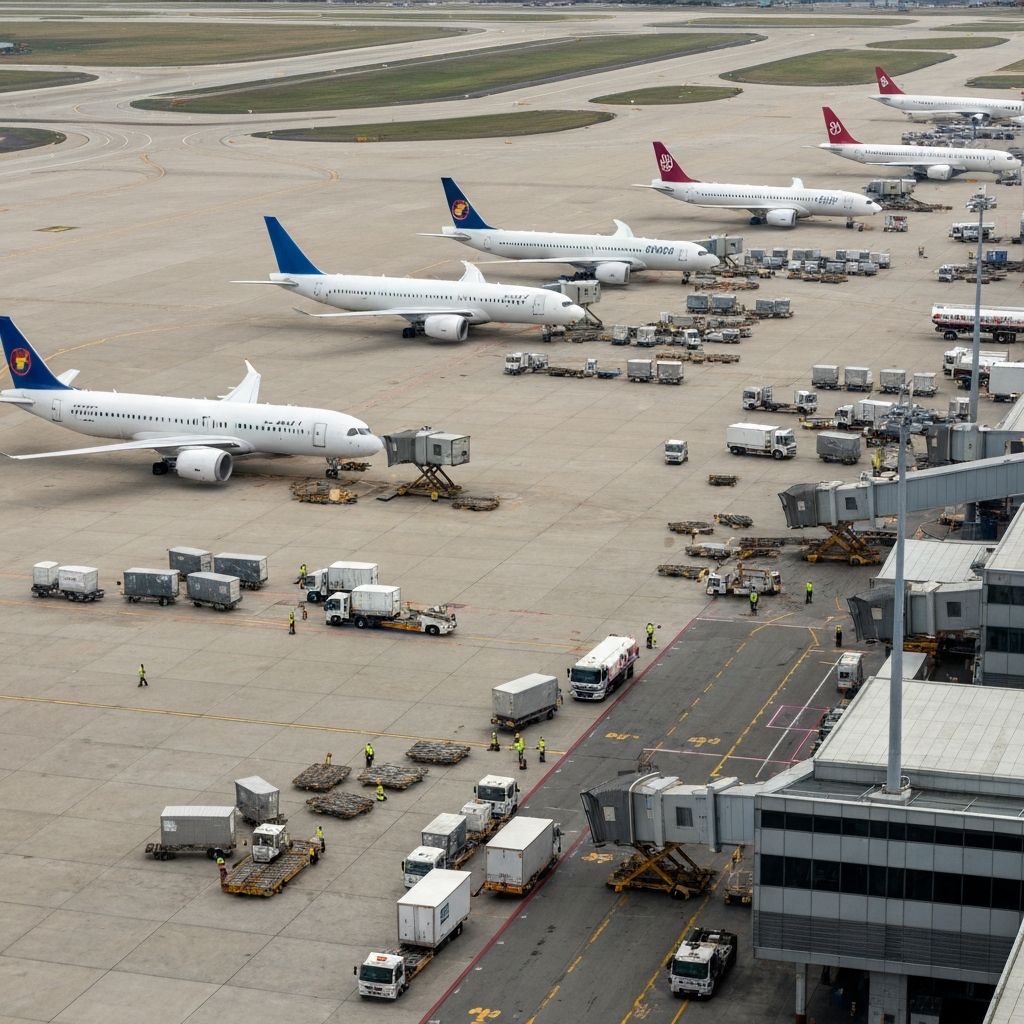
Touchway Apron Control
Touchway Apron Control is real-time apron control (apron management) software for airport operators, airport operations centers, apron control units and ground handlers. It gives live visibility of aircraft, vehicles, GSE and teams, supports stand allocation and raises AI-assisted safety and conflict alerts, combining GPS, RFID, ADS-B and IoT data — and it is in operation at Viracopos International Airport, Brazil.
The apron under airport coordination, with total situational awareness
A turnkey Apron Management solution: surface surveillance via ADS-B, enriched by the analytics of the cameras already installed at the airport, integration with AODB/AMS and tower electronic strip systems, towing management, systemic handover with the tower and a complete operations room — so the airport operator can safely take over coordination of every aircraft movement on the apron.
- Surveillance
- ADS-B + video analytics
- Integrations
- AODB/AMS · Tower strips · CCTV
- Hosting
- Private cloud, HA cluster
- Operation
- 24/7 · real time
One screen for the entire apron
Flights on ground, aerodrome map, electronic strips, alerts and per-stand turnaround in a single interface — refreshed every second.
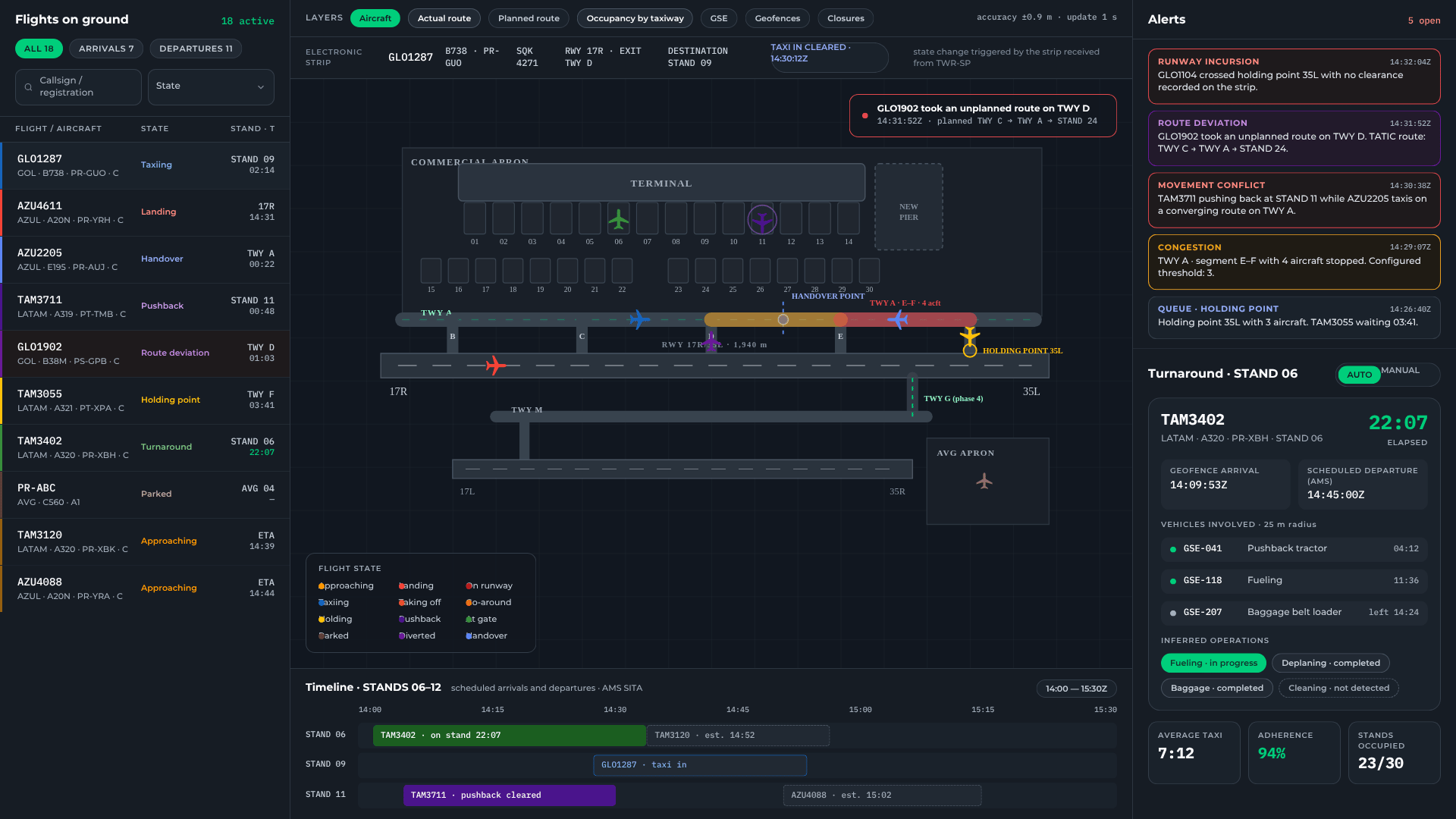
- Flights on ground
- State of every aircraft — landing, taxiing, handover, pushback, turnaround — with stand and timing.
- Apron map
- Actual and planned routes, occupancy by taxiway, GSE, geofences and closures as layers.
- Operational alerts
- Runway incursions, route deviations, movement conflicts, congestion and holding-point queues.
- Turnaround by stand
- Vehicles involved, inferred operations and a stand timeline fed by the AMS.
Constrained aprons leave no room for improvisation
At airports with few stands, steep peak hours and ongoing construction, every pushback, tow and taxi on the apron ripples through the network. Apron Management moves that coordination from the tower to the airport operator — and demands technology to match.
Capacity at the limit
Few parking stands, aircraft code restrictions and nearly linear demand throughout the day require stand and route decisions in seconds.
Shared responsibility with the tower
The airport coordinates the apron, ATC keeps the runway. Without a clear, system-driven handover, radio and hotline traffic multiplies.
A layout that changes with construction
Temporary closures, new taxiways, new stands and altered flows at every construction phase must be reflected in the system without extra development.
System-driven handover between tower and apron
The handover point is where responsibility changes hands. The platform exchanges data with the tower's electronic strip system and the AODB/AMS at every step, auto-fills fields and keeps tower and apron looking at the same aircraft, at the same instant.
Arrival
- TWR / ATCStrips TWR → Apron
Touchdown and runway exit
Apron receives touchdown and the preferred inbound taxiway to the most convenient handover point.
- Handover point
- Apron ManagementElectronic strip
Pick-up at handover
The aircraft takes arrival status on the map, with an AI-suggested route to its allocated stand.
- Apron ManagementVideo analytics → Apron
On-block and turnaround
Real-time turnaround activity status from the airport's camera analytics, with delay alerts.
Departure
- Apron ManagementApron → Strips TWR
Pushback or tow approved
The apron operator approves the movement and the information is sent automatically to the tower.
- Apron ManagementApron → AODB / Strips TWR
Apron taxi
Preferred outbound taxiway towards the handover point, avoiding conflicts and closures.
- Handover point
- TWR / ATCStrips TWR
Transfer to tower
The tower receives the aircraft with full apron awareness for the holding point and take-off.
Everything the apron operator needs, on one screen
Real-time visualization of aircraft, vehicles and apron resources, with business rules the operator configures on their own — no vendor development required.
Surface surveillance
- Aircraft on aprons and runways in real time via ADS-B, enriched by the airport's camera analytics
- Detailed data and chronology for every flight, on ground and in transition
- Configurable icon size to tell aircraft categories apart
- Automatic logging of landings, take-offs, paths, go-arounds and stands
Dynamic status and visuals
- Statuses built from dynamic rules, filterable and sortable like any column
- Configurable colors by flight phase, arrival, departure or pushback approved
- Timeline of scheduled and estimated arrivals and departures per location
- User profiles for viewing, execution and administration
Events and aerodrome configuration
- Temporary taxiway and stand closures
- Flow changes, new stands, hangars and taxiways per construction phase
- Registry of aircraft, airports and airspace conditions
- Business rules created without vendor development
Safety alerts
- Runway incursion and potential movement conflicts
- Congestion at holding points and at handover
- Turnaround delays and events detected by video analytics
- Configurable areas of interest for collaborative decisions
Towing management
- Availability, conflicts and impact on apron flow at a glance
- Historical playback of every movement
- Operational scenario simulation
- Continuous tow coordination, overnight included
AI-assisted routing
- Best-route suggestions across the apron
- Stand release prediction
- Automatic avoidance of closed taxiways and stands
- Conflict prevention between simultaneous paths
Connected to the systems the airport already runs
The platform integrates with the categories of systems the airport already uses, auto-filling information between them and cutting voice communication down to what really matters.
AODB / AMS
- Receives and fills flight information
- Preferred outbound taxiways sent to the tower
- Automatic filling of operational fields
Electronic flight strips
- Receives touchdown/lift-off and inbound taxiway
- Status changes through electronic flight strips
- Sends approved pushbacks and tows after handover
Video analytics
- Real-time turnaround activity status
- Stand release data
- Delay, conflict, incursion and congestion alerts
Airport CCTV
- Integrates with the cameras and analytics already installed at the airport
- Video events correlated with ADS-B surveillance
- Enriched data on the video wall and workstations
Identity provider
- Authentication with the airport's corporate credentials
- No agents to install
- Every transaction tied to a user
Query interface
- Airport team access to run their own queries
- Scheduled batch processes
- Parameterized, reusable customizations
Every integration built as REST web services over HTTPS, with encryption for sensitive data.
An operations room ready to run
Beyond the software, we deliver the ADS-B surveillance and communications infrastructure, and connect the cameras the airport already has, giving the apron operator full situational awareness.

Multi-screen workstations
Each operator position with at least six full-HD monitors showing electronic strips, AODB/AMS, apron surveillance and the airport's camera feeds.
Integrated voice at the position
Apron frequency to reach pilots, a hotline to the tower and UHF radio to vehicles, apron marshals, handlers and airlines.
75" video wall
High-definition screens with the real-time airport map, ADS-B movements and events from the airport's camera analytics.
In-room FIDS
Flight status, delays and cancellations always in view of the coordination team.
Certified ADS-B antennas
Detailed design with antenna quantity and placement covering the whole airport site, valid for every construction phase, with telecom certification.
All-weather operation
Electronic surveillance that keeps situational awareness through low visibility and bad weather.
Every recorded movement becomes a KPI
Reports, trend charts and a timeline with the flights and paths operated. Templates the operator configures to find bottlenecks and continuously improve apron performance.
Available indicators
- Usage frequency
- Runway ends and runway exits
- Taxi time
- Impeded and unimpeded, per segment and airline
- Movements and stops
- From push to start of movement
- Time on stand
- Turnaround per stand
- Speed
- Aircraft and tugs
- Movement counts
- Per period and area
- Queue length
- Holding point and waiting for stand
- Diversions and go-arounds
- History and trend
- Scheduled vs estimated demand
- Arrivals and departures
Configurable dashboards, periodic reports and Excel export.
Built for operational criticality
A system that coordinates the apron cannot stop. The architecture is designed for high availability, full auditability and data-protection compliance.
Private cloud
Dedicated environment with documented topology and redundancy, maintained by the vendor.
Clustered high availability
If one machine stops, resources move automatically to another server.
Automatic load balancing
Resource usage evened out through seasonal peaks and batch processing.
Operational backup
Contingency built in to keep apron coordination running in degraded scenarios.
Corporate SSO
No passwords stored in the product; any residual credential is encrypted.
Full audit trail
Logs for every operation, database auditing and configurable retention.
LGPD / data protection
Sensitive data preserved, auditable and approved by its owners.
Release management
No direct database changes; only scripts approved by the airport.
Apron Management
What you need to know about operator-led apron coordination.
What is apron control?
Apron control is the coordination of aircraft, vehicle, equipment and people movements on the airport apron, from stand allocation to pushback and towing. Touchway Apron Control is software that gives the apron control unit a single, live picture of that activity with stand allocation, safety alerts and conflict detection.
Who uses Touchway Apron Control?
Airport operators, airport operations centers (AOC/APOC), apron control units and ground handlers. Each team sees the same real-time map, with views and alerts tailored to its role.
How does it integrate with the AODB and flight systems?
It connects through APIs to the AODB/AMS for schedules and stand allocation, to the tower's electronic flight strips for the tower–apron handover, and to flight data feeds. It complements existing systems instead of replacing them.
What data does it use?
ADS-B surface surveillance for aircraft, GPS telematics on vehicles and GSE, RFID tags on equipment, IoT sensors, events from existing video analytics cameras and flight data from the AODB. AI combines these sources to detect conflicts and suggest actions.
Where is it already in operation?
Touchway Apron Control is in operation at Viracopos International Airport (VCP) in Campinas, São Paulo, Brazil.
How does the handover between tower and apron work?
The handover point is defined in the operational concept. On arrival, the system receives touchdown and the preferred inbound taxiway from the tower's electronic strip system; on departure, it sends approved pushbacks and tows and the preferred outbound taxiway to the tower. Electronic flight strips are updated automatically, reducing radio and hotline traffic.
Does Touchway supply the apron cameras?
No. The solution integrates with the cameras and video analytics already available at the airport, using their events to enrich the ADS-B surveillance and turnaround data shown to the apron operator.
Does the solution adapt to airport construction phases?
Yes. Operators create events such as temporary closures, new stands, new taxiways and flow changes without vendor development. The ADS-B antenna design is also sized to work across every construction phase.
Where is the system hosted and how is it protected?
In a private cloud with clustered high availability, automatic load balancing and operational backup. The application is hardened against SQL injection, XSS, DoS, MITM, privilege escalation and buffer overflow, with a full audit trail and data-protection compliance.
What happens to the infrastructure at the end of the contract?
All deployed infrastructure is transferred to the airport through a structured transition plan, complete technical documentation and knowledge transfer, ensuring team autonomy with no service interruption.
Taking over coordination of your apron?
Talk to our team about the operational concept, integrations and infrastructure to implement Apron Management at your airport.